“Gardeners, I think, dream bigger dreams than emperors.” Mary Cantwell

How Is Theme Coloring Your Life?
If I asked you, "Is the glass half-full, or half-empty," how would you answer? Your answer is likely to give me a snapshot view of your point of view. For instance, if the answer is half-full, you may view your life with more optimism than someone who answers half-empty. Even given the same events or similar circumstances, the two of you have different filters - or, themes - coloring how you perceive the meanings of them. This begs the question, "What Theme of yours is coloring your life, and is it helping or hindering your growth?"

Authors know that Theme, or Point of View, colors all aspects of their stories. Consider Theme to be like a frame through which Authors perceive and present what unfolds for their Heroes: it is a filter, a lens.
“I hold that Theme also applies to our real-life experiences. Wittingly, or unwittingly, your Theme affects the events, people, and circumstances that your Hero-self experiences - so YOU can process all aspects of it over time. In doing so, you have the opportunity to become a fuller expression of yourself.”
Are you familiar with the common expression, “Is the glass half-full or half-empty?” Depending on your answer, folks may assume your worldview is generally optimistic or pessimistic. This means that given the same facts of an event, a Half-Full person will have one story to tell, and a Half-Empty person will have a different story.
I share this example to illustrate how a point of view, a filter, influences a Hero's perception of things unfolding in her life.
There's another function of Theme. In stories about transformation, there is an arc: a progression unfolds along the Theme. We typically witness the Hero suffer on one side of the thematic coin, struggle to change, and ultimately fail or grow after experiencing the other side of the coin.
Ever heard the phrase, "Your vibe attracts your tribe?"
Let's look more closely at this concept by talking about George Bailey, the Hero in the story, "It's A Wonderful Life."

How would you describe the Theme of this story?
George Bailey lives in a small town where his father runs a local business. All George wants is to leave the town and "see the world!" Over the course of the story, you guessed it, he keeps getting blocked from ever leaving. At his lowest point, he has had so many obstacles and disappointments that he considers drowning himself.
Let's say that the Author of George's story chose Sacrifice as a Theme.
“If you’re not sure how to describe a main theme for your Hero, take a look at the message your Antagonist, or Villain, has for you. In George’s case, it’s his town’s misanthropic businessman, Mr. Potter. Every time Mr. Potter talks about or to George, his message to him is ‘you’re a nobody, you can’t get what YOU want, your wants are hopeless.’ In other words, to keep beating his villain, George will have to keep sacrificing what he wants.”
Looking at the events and people that unfold and play in George's life, under this thematic umbrella of Sacrifice, observe these mini-themes he comes to realize/overcome/accept in his life:
- Missed opportunities
- Compromise
- Adaptability
- Desperation
- Silver Linings
- Community
- Accepting help from others
- Valuing himself
By the end of the story, George comes to view his sacrifices in a new, empowering light: he sees the positive ripple effect his choices have had, and he embraces others' sacrifices to help him when he's in need.
What if the Author chose Redemption as a Theme, instead of Sacrifice?
If Redemption colored his story, the events and people that keep George from ever leaving his town would be more of his own doing. Mr. Potter's messages to George would be more about his culpability and unforgivable-ness, right? 'You're a screw-up, a criminal. You always make things worse. You'll never do the right thing.'
In this case, instead of coming to a place of considering suicide, perhaps George would come to consider the most desperate, irredeemable act he could imagine to relieve his desperation: a crime, a betrayal, an abandonment.
Mini-themes to unfold might look more like this:
- Missed opportunities
- Irresponsibility
- Ambition
- Selfishness
- Laying blame
- Creativity
- Integrity
- Community
- Forgiveness
These two examples demonstrate how Theme frames the events and choices that George, the Hero, might encounter. He's still George, a guy who lives in a small town who wants to see the world. But, the details along the path to what he wants are colored by the Author's theme for his story.

So, you. You're the Hero of your story AND the Author. With your Author hat on, you can step back and examine what filters you're bringing to your life experiences.
If you uncover that you're programming your story with a Theme that's bringing out the worst in you too often, experiment with reframing it.
Start with this. Dig in and ask what is the "mean message" you get from people (or yourself) that feel like villains?
A black cloud always follows you. You're not smart. You're too slow. Nobody will love you. You can't do anything right. You're not my equal. You can't leave me.
Now, what is a word or phrase that is the TOTAL OPPOSITE of that "mean message?"
Sunshine & Silver Linings, That's Me. I'm A Smart Cookie. My Pace Allows Me To Do Stuff With My Best Effort. I Am So Loved. I Do Things Well With Focus & Ability. I Deserve Respect. I Deserve Independence.
Between the "mean message" and its opposite, is there a word that describes a Point of View behind them?
A life-long theme for me is Constancy. I've gotten insights before about being here for Patience, but my understanding of this has evolved.
Over the course of your life, imagine your story is a series of books, not just one. Within each book, you'll have chapters with sub-themes that contribute to your understanding of your story. From Book One to Book Ten, the theme in the first one might be Inspiration, and in the tenth one it might be Constancy in Service to Inspiration.
In my case, I've had difficult chapters with the following titles:
- Too Many Choices
- Talented, But Not Successful
- Overwhelm
- Can't Do This on my Own
As I've struggled through these, I've come to understand the necessity and value of Constancy as a core theme for me -- which enables me to make choices going forward that foster my personal growth, not stymie it. I choose to color my experiences through this filter - not lenses such as, "I never finish anything. I can't stick with something, because I always get bored. I can't decide what to do, or which path to pursue..." because I choose improvement and growth for my Hero self.
How about you? As the Author of your life story, what Theme do you want coloring your Hero's experiences?

What Are Your Supporting Characters Showing You About Your Hero Self?
In storytelling, Supporting Characters reflect potential mirrors of the Hero, or challenging aspects of what s/he wants, or the limitations/triumphs of potential outcomes. The point is, they serve a purpose to advance the Hero's story. They do the same thing in Real Life. In this 9-minute video, I use "Star Wars" to explain what I mean.
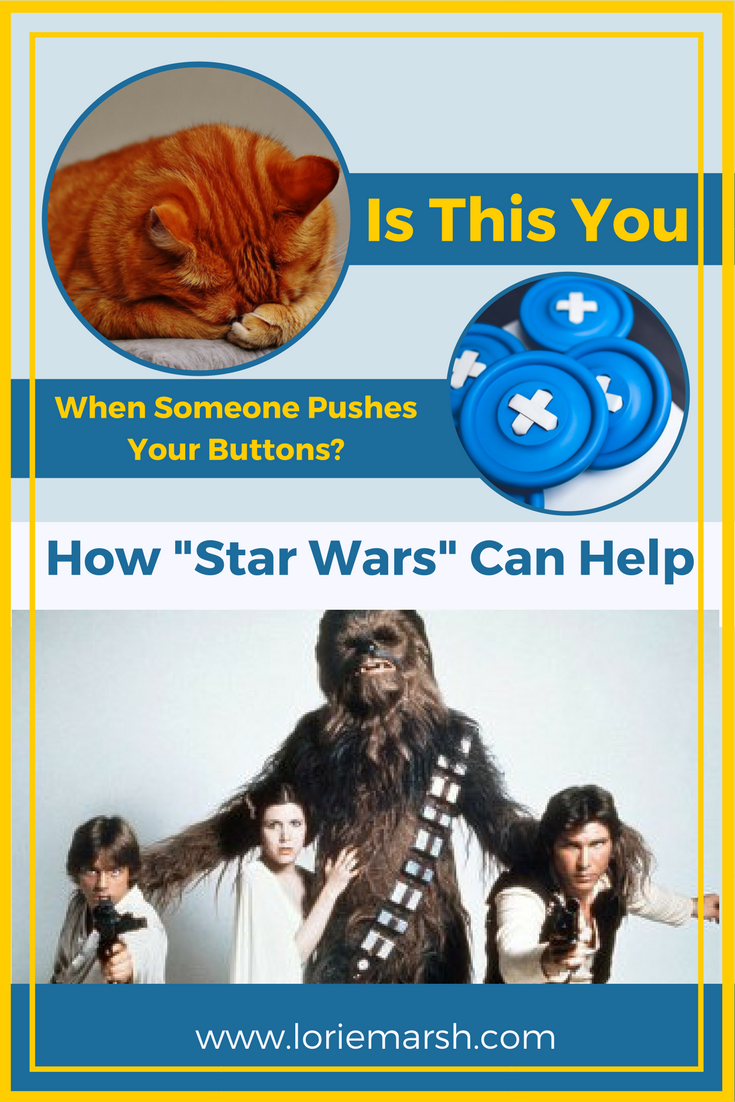
Let's talk about Aunt Edna. You love her, of course, but the woman gets on your last nerve. The thing is, she's always there when you go to your mom's house, so avoiding her completely isn't on the table. You think she's a bit of a bully, and she seems to know exactly how to get under your skin. What is UP with that??
Guess what? You have something in common with Luke Skywalker. Seriously.
The main character in the first Star Wars trilogy is surrounded by Supporting Characters, and so are you.
A Supporting Character is somebody who affects the Hero's story in some way. It may be someone with whom the Hero interacts often or merely an acquaintance. But, their presence, brief or long-term, molds the Hero's story directly. The purpose of Supporting Characters is to deepen our understanding of the Hero and often, the Hero's understanding of himself. They reflect how the Hero might evolve, deal with obstacles, or they may demonstrate aspects of what s/he wants.
Consider, Luke Skywalker.
Luke is a restless young man, desperate to BE SOMEBODY, to prove himself away from his desert planet home. As his story unfolds, he meets Princess Leia, Han Solo, and Yoda. Each of these Supporting Characters represents elements of Luke's possible path forward.

+ Princess Leia is charismatic, powerful, and focused on a Great Cause, the Resistance, to triumph over the dominion of the Empire. Her wants and motivations serve the common good.
+ Han Solo is a mercenary. He's motivated solely (at first) by self-interest. He's charismatic, clever, and good at what he does; but, he's fundamentally selfish.
+ Then there's Yoda, the Jedi master. Yoda is the character who represents the fullness of what Luke might become: masterful, powerful, and wise.
Each of these characters informs Luke's growth from impulsive, impatient young man to a wiser, more sober novice Jedi knight. Of course, Luke doesn't identify any of these people as Supporting Characters, but the Author of this story, George Lucas, would. The clincher is that you happen to be both Hero AND Author of your story.
“Look at folks in your life as Supporting Characters. Who might be a reflection of your wants, your weaknesses, or your desired outcomes? What can you learn from them? ”
Who might be your Wise Friend/Mentor like Yoda? It might not be who you think. Your Yoda might be that teacher, trainer, boss, barista, postal worker, fellow transit-rider who always seems to bring out the best in you, even if they challenge you often.
About those folks who "push your buttons," is their presence supporting your growth in the long run? Does interacting with them challenge you to resolve poor patterns, accept responsibility, or forgive and let go of "old stories?"
If not, remember you are the Author; consider removing them from your story. Or, "rewrite" them as Background Players. Ha!
Your life is your story; as the Author of it, what you can change about your relationships with your Supporting Characters is how you choose to engage with them in Hero mode.
May the Force be with you. :)

Empower Your Self-Talk With "High Vibe" Words
Wants and needs, frustrations and worries: we all have running thoughts (little stories) about all of these each and every day. In this 17-minute video with Soulful Storyteller, Carrie Severson, she explains what "high vibe" words are and how to re-frame our little stories for empowerment and flow.

Carrie Severson
I'm delighted to introduce the Soulful Storyteller, Carrie Severson!
Carrie works with people who want to share their stories as public speakers. As a bonus for the clients and students in my private Facebook group, I hosted Carrie via video chat last month to learn how to use her concept of "high vibe" words to empower our stories about our lives.
Click the image to view the 17-minute video.

You Are Hero & Author of Your Life Story
Being the Hero of your life story means you are the Main Character, but what does being the Author mean? In this 4-minute video, I share author Michael Singer's concept of the "Inner Observer," and relate it to putting on your Author hat to evaluate and improve your life.

Click on the image to view the video.
Going through your day-to-day life, you may not feel like a "hero." Heroes are confident, right? They perform extraordinary feats. They save the day! But, being a hero is not limited to these scenarios.
Simply, by thinking of your life as an epic story, that makes you its main character, its Hero. The bonus is, that you're also its Author. In Author mode, you can tap into the quiet place in your deepest self and take a high-level look at the happenings in your life like they are events in a story.
In this four-minute video, I share how I view my Author-self as a timeless Inner Observer, and why.