“Gardeners, I think, dream bigger dreams than emperors.” Mary Cantwell

You Are Hero & Author of Your Life Story
Being the Hero of your life story means you are the Main Character, but what does being the Author mean? In this 4-minute video, I share author Michael Singer's concept of the "Inner Observer," and relate it to putting on your Author hat to evaluate and improve your life.

Click on the image to view the video.
Going through your day-to-day life, you may not feel like a "hero." Heroes are confident, right? They perform extraordinary feats. They save the day! But, being a hero is not limited to these scenarios.
Simply, by thinking of your life as an epic story, that makes you its main character, its Hero. The bonus is, that you're also its Author. In Author mode, you can tap into the quiet place in your deepest self and take a high-level look at the happenings in your life like they are events in a story.
In this four-minute video, I share how I view my Author-self as a timeless Inner Observer, and why.

Storytelling for Personal Growth
Our lives are epic stories, in which we are both Heroes and Authors. What makes for good storytelling can be used for personal growth.

Something happened! Or, nothing happened. In the telling of whatever happened, we create a story.
Stories help us filter our experiences and make sense of Life. Sharing them can foster a true connection with others and a deeper understanding of ourselves. Or, not.
Depending on the stories in your personal rotation, you might feel stuck: cut off from meaning, empowerment, and authentic connection with others.
That sounds isolating and craptastic to me.
You are the author of your own epic story. I believe if you become familiar with the essential elements of storytelling, you can use them for personal growth: to change up your story.
So, what are these elements?
Traditional storytelling includes:
a hero/ine (that's you),
what the hero/ine wants,
a setting (where things take place),
supporting characters (friends, family, strangers, pets, Yoda),
and an antagonist (the overwhelming obstacle, the villain).
The final piece of the puzzle is theme, or how the story is framed.
What the Hero Wants
Over the years, I've worked with writers of all stripes, and one of the hardest questions for them to answer is, 'What does your hero want?'
It's a story about this one-legged miner who discovers his company is cutting corners on safety inspections, and he gets trapped with ten others below ground when the --
That's what happens to him. What does he WANT?
Uh, well, he wants to get rescued.
Okay, good. What else?
What else?
Yes, he has an exterior want - to survive. That's a reasonable reaction to his situation. But, people have interior wants, too. For instance, he wants to survive in order to... what?
He wants to blow the whistle on the unsafe conditions. He's tired of being treated like he's expendable. He wants to stand up to his boss.
Ah. He wants to stand up for himself.
From there, I can help the writer view his story anew to see if and when the hero's wants stay consistent. If the story veers off in the middle with an alien invasion, that can be a fun distraction -- but, it won't belong there unless it moves the hero toward what he wants: to survive and to stand up for himself. Only if the writer can connect this alien incident + the hero's actions toward getting what he wants, should it stay in the story.

You as the Hero- What Do You Want-
Here, I'll complete one for myself:
Lorie is a story about a compulsive creative with bouts of depression
who really wants to make art that reaches people
in order to finally feel she is serving others with her gifts.
Oooh, that's clarifying, isn't it?
Let's put these as sticky notes on our bathroom mirrors, shall we? That way, over the weeks and months of THINGS THAT HAPPEN -- mini-catastrophes (flooded basements), fleeting triumphs (the toddler used the toilet!), and daily distractions (bills, commuting, grocery-shopping, work) -- we can decide what belongs in our long-term narratives, and which incidents are simply distractions to be experienced and let go.
Setting and Supporting Characters
In a written story, an author has the luxury of choosing her settings and supporting characters with an eye toward those that will shape the hero's journey for his personal growth.

Is this the setting for a happy story, or a mystery? You can decide.
For instance, in our miner's story, would you imagine a setting that includes blue skies and singing animated forest animals? No, I'd expect perhaps descriptions like dingy, cramped, or stagnant, myself. Or, even the reverse: huge, impersonal, and overwhelming.
Seasoned authors share details about the hero's work environment, home, and hangout places to reflect his state of mind at the beginning of and throughout the story.
Same thing with supporting characters. The author might choose to include an oppressive or demeaning boss, and fellow miners who ostracize the hero for some reason.
But, authors also remember to include an ally, a friend or family member (or even unexpected stranger), who supports the hero's growth. Always keep an eye out for encouragers and helpers (both in stories and Life)! They are there.
Here's the kicker. I believe the settings and people we encounter in our daily lives reflect our inner stories.
So, if your surroundings and supporting characters suck, it's time to work on changing your story. After all, you're the Hero and the Author.
I'm not saying that your changes must be drastic - although, moving to Paris does sound exciting.
Changes might be as simple or difficult as going someplace you never go (a museum instead of the movies, a garden center instead of the convenience store, a coffee shop in a new neighborhood) or stretching yourself to smile at a stranger at the post office.
How about any encouragers or would-be-helpers in your life? Are you overlooking any folks in your orbit who bring out the best in you most of the time? Lean toward them more. Accept authentic kindness. Embrace new "types."
But, what about that person who always pushes your buttons?
Take a moment to view yourself as the Author, not the Hero (who's down in the weeds of the story): what if this supporting character was removed? Or, can your hero take a lesson from this character, grow from it, and move on?
What if this person feels bigger than just a supporting player?
Who or what is the villain, the antagonist, the overwhelming obstacle in your story?

Movie Still - Perils Of Pauline
Do you find that you keep running into conflict with a certain person or personality-type, bad romances, loneliness, money troubles, or soul-sucking work?
If anything feels like a wall you keep hitting and just can't demolish, then it might be the antagonist in your story.
In storytelling, antagonists raise "the stakes." They put up obstacles that threaten to stop the heroine from getting what she wants. As a reader, the higher the stakes, the more connected to her story you feel. You want her to persevere and triumph.
In your own life story, you grow by overcoming the stakes raised by your antagonist.
My antagonist is The Taskmaster, and she lives in my head. She's harsh, vocal, and mostly unhelpful:
You're barking up the wrong tree -- again.
You really lack discipline, commitment, restraint, fill-in-the-blank. Pull it together.
You always _____________. You're a disappointment.
Think of something in your life that consistently makes you feel bad about yourself or stops you in your tracks. It might be a person, a situation, or even a part of yourself. What is the message you get from this source?

Who or What is your Antagonist?
Here's mine:
A gloomy and harsh inner critic.
My Taskmaster wants immediate perfection and to always know the answer.
Her message is, 'You're not enough.'
Let's all make faces at our antagonists now. Flipping of the bird is optional.
In the best stories, the stakes raised by the antagonist cause the heroine to go through a whole spectrum of experience. She'll wrestle mightily with "both sides of the coin" during an arc of overcoming her nemesis.
If you feel like you're going through the ringer while dealing with your antagonist, you're on the right track.
You've tried A. You've tried Z. You can't give up, yet you can't triumph either.
Try this instead.

Hero's Counter Message
Here's what I've come up with:
You're not enough.
I am enough.
My Taskmaster is hooting at me right now.
You are enough. Enough what? Ha! What a cheesy idea, you weirdo.
For me, defeating my antagonist means I must lean in against her resistance, her disapproval, her fears. I must assert my counter-message and disarm her:
This idea is enough. My own message is important. I am enough.
If I am to keep growing, if I am to be of any service to others with my unique gifts, I must overcome her message and the effects it has on me.
Write down your counter-message. Say it out loud. Feel silly while doing it, but do it anyway. In fact, if you feel, 'Ew!' while mouthing it, you've probably nailed it. This is a powerful step toward disarming your antagonist.
It's time to talk about theme. Theme informs our villains.
Theme
There is an adage that there are no original stories. Every new story is a remix of the same familiar plots: rags to riches, overcoming impossible odds, undone by a tragic flaw, a life-changing experience/voyage, etc. But, what does make a story original is its theme.

How do you frame things that happen?
Theme reflects an author's point of view; it's how she frames her story.
In traditional stories, there is an arc: a progression unfolds along a theme. We typically witness the hero suffer on one side of the thematic coin, struggle to change, and ultimately grow after attaining/experiencing the other side of the coin.
Take the story of our miner. If you were the author, and I asked you to sum up what the story is about IN ONE WORD, how would you answer?
Respect?
Justice?
Redemption?
Let's say you chose Respect.
At the beginning of this version of the story, we'd see that the miner has no respect for himself and doesn't expect nor get it from others. Over the course of the story, you'd add plot points to raise the stakes: he is berated by a co-worker; he is turned down for a promotion; he is cheated on by his lover. Finally, he is trapped underground, facing death.
In all your plot points, his antagonist's message would be, 'You are worthless, who'd respect you?'
In order to defeat his antagonist, your miner must learn to embrace his own message: 'I am worthy of respect.'
The miner's choices will finally come down to give up and die, or work to change his belief about his worthiness for respect. He will suffer and struggle to assert himself; but, he will rally and develop respect for himself and command it from others.
Let's try Redemption instead as another example. We might include most or all of the same plot points as above. But, in this version, they would instead demonstrate how the miner feels irredeemable, and how others suffer by his unforgivable action(s). Maybe he's the one that causes the mine collapse. His antagonist's message might be, 'You must be punished.' and he'd have to work on embracing a counter-message of, 'I forgive.'
Theme frames what you emphasize with your story. If only sucky things seem to be the emphasis in your life as the Hero, put on your Author hat and try to figure out your theme. Armed with this bigger picture, you can work to change your emphasis.
A place to start is to look at the message your Antagonist has for you.
One person's ogre is another person's pussy cat. The antagonist that you have is the one that will spark you to grow. Nobody else at all may be affected by your antagonist's message, but it might give you a clue about your story's theme(s).
Next, note the way you tell stories about your life.
Imagine we're sitting in a car together, and you're telling me about your day. You woke up, you got dressed, you ate things, you did things, and now you are on your way home. Write down what you'd share with me.
Now, I want you to imagine yourself alone with your thoughts in your car. Does your mind wander to the same areas all the time? What makes you so frustrated over and over?
Conversely, tell me a favorite daydream.
Look at your notes. Do the same words or phrases appear? If not, try assigning colors to each word or phrase you've written. Do any of the same colors appear? Assign adjectives to the colors: moody, pent up, peaceful, overwhelming, mental, creative, and so on.
What's tumbling out? Look for any patterns. We're working more art than science here.
Finally, check your gut.
You might not know HOW you know, but you realize that a life-long theme for you is ____________________________________.
Life unfolds in so many, many chapters!
A life-long theme for me is Constancy. I've gotten insights before about being here for Patience, but my understanding of this has evolved.
Over the course of your life, imagine you're the Author of a series of books, not just one. From Book One to Book Ten, the theme in the first one might be Ambition, and in the tenth one it might be Ambition in Service to The Collective Good.
Within those books, you'll have chapters with sub-themes that contribute to your understanding of your story.
In my case, I've had chapters with the following titles:
Too Many Choices
Talented, But Not Successful
Overwhelm
Can't Do This on my Own
As I've struggled through these, I've come to embrace the necessity and value of Constancy as a core theme for me. Recognizing this enables me better to make choices that foster my personal growth, not stymie it.
I fall down. I take a deep breath. I am enough. I get back up. If it takes time to get back up, it takes time. I still get back up to share whatever gifts I have.
The Big Recap
Your life is an epic story. There is power in how you tell it. Use how you tell it to foster your personal growth.
If you find your Hero-self down in the weeds of any chapter in your life, I recommend you put on your Author hat and ask yourself:
What do I want?
Is my setting bringing out the best of me?
Who are my peeps? Am I tuned in to my helpers and encouragers?
What message am I getting from my Antagonist? How do I turn that around?
And, finally, how am I framing what's going on? Do I want to keep this point of view, or shall I modify or change it?
Now get out there and shine light into the darkness with your story.

Of Success... and Naps
Success can't exist without failure... and naps.

How am I going to make this successful??
Have you ever tormented yourself with this question?
Me, too.
I told myself when I began this site that I would focus only on creating content for the first six months. I have a lovely, Large Brain that likes to Figure Things Out; and, it can spin out into Monkey Mind Land if I allow it to think it's in charge. So, details like how many visitors I might have; whether my posts are primed for ideal Search Engine Optimization (SEO); or, how to monetize my efforts if possible: I decided nope, nope, nope, not gonna put the cart before the horse.
Focus on showing up consistently, Lorie. Challenge yourself to express your unique voice. Put the What ahead of the How for the time being. Commit to and do these things for six months, call it a personal success, and take your next step.
Feel the Zen there?
Then I came upon Melyssa Griffin and The Nectar Collective.
Oh, boy! Her content is motivating and aspirational. It dives deeply into various Hows of building an audience for your website. I love her writing voice, the topics she covers, and the can-do outlook that comes across in her postings. I admire her work and revenue results.

O! So many rabbit holes...!
What a shiny Rabbit Hole!
I easily spent a few hours on her site over a couple days. I got ideas. I joined a Facebook Group she administers. I even signed up for an e-course she has about building email lists. It's polished, thorough, and just spiffy six ways to Sunday. Plus, links off her site led me to other data, reviews, opinions, case studies, and how-to's.
More rabbit holes...
Then yesterday, I kinda freaked out. I felt inferior and inadequate when I sat down to write. I felt overwhelmed and distracted. I tried to shake it off and managed a couple feeble sentences, but in my head I heard --
Maybe I'm barking up the wrong tree with this site? I don't know about X... and, my J is non-existent. Ack! Maybe I'll never be successful.
Imagine here a sucking sound, like a toilet flushing.
Time for a Monkey Mind Shutdown.
I walked away and took a nap.
What is success, anyway?
Ask any person, and their answer will vary.
Me? For years and years, success meant that I would finally "make a living" being a creative person and entrepreneur. I'd bring in enough income to pay off credit cards. In fact, I'd bring in enough income to fund a philanthropy! Let's think big, right? Success would be winning that contest, grant, or fellowship, producing an acclaimed play or income-producing independent movie, or getting a gig with that awesome company doing X.
Success meant I'd get paid for my creative vision and output.
Success also meant autonomy, leadership, and industry respect.
Guess what? Most of these outcomes have not been part of my path so far. If success is only defined by what I have achieved of my goals, I'm a failure.
Yep. A failure with a capital F. Fale-yur.
As such, my notions of success have evolved: working repeatedly with talented, kind collaborators feels like success. Learning to say "yes" to things that scare me in a challenging, good way, and saying "no" to things that I'm afraid to pass up due to fear of missing out - success. Trusting in stillness when I'm not sure which way to go (or my mental monkeys are haranguing me)...
Strangely enough, when I walked away for a nap yesterday, that was a success for me.
I didn't allow myself to wallow in anxious dreck. I knew if I came back around after a "reboot," I'd find my way back to the flow. I knew I'd be okay, because I believe in myself. It's taken a long time to get here, but hey, if you fall down and get back up enough times, you learn you can.
Success means getting up again, failure after failure.
You! Yes, you there.
If you sense an inner voice that calls to you to try something "crazy," change direction, make a new, different, unfamiliar choice, or even pick up your toys and go home, and you heed it, that's success. Even if it fails. Even when it fails. Because, you will learn a little something, pick yourself back up, and try again. After a nap.
That is belief in yourself, the greatest success of all, in my book.
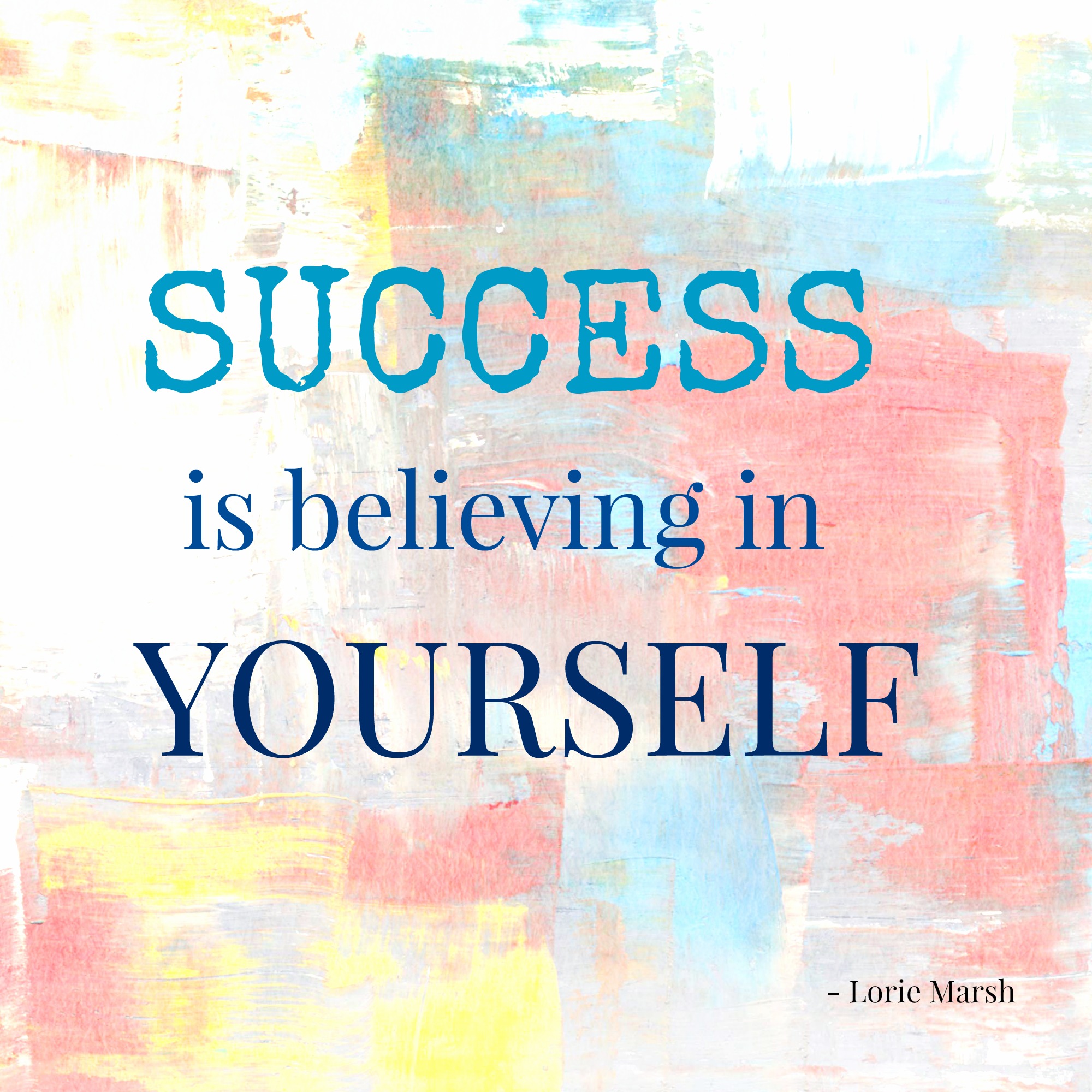
Success-is-belief-in-self-quote

Stories We Tell Ourselves
Are the stories you believe about yourself fostering your growth, or holding you back?

I'm not _____________ enough. Fill in the blank.
On ten different days, you might come up with ten different words for that blank. But, chances are, there are a couple words that always come up in the stories about yourself that you hold as truths.
Me?
I'm not artistic enough. Not outstanding enough. Not disciplined enough.
When I was a Freshman in high school, I took an Art class that made a huge impression on me. My weathered teacher looked like a cross between a female Dick Van Dyke and a stork. She was a disheveled, kooky mess, and I loved her. I loved the media she exposed us to, the exercises she had us do, and I was enthused and proud of the work I made in class.
But, I wasn't Paul.
He was prodigiously talented. So much so, the school administration asked him to paint a wall-sized mural outside the main office. In piercing teenage angst, I felt, 'I must not be as talented. My art isn't that good. I'm not a "natural" like Paul, and I guess I never will be.'
Boy, I wish I could take my 14-year-old self aside and rewrite that script right there!
So, last week, a dear former collaborator contacted me about helping out on a project, and I felt myself facing a gaping rabbit hole of old stories.
I'm a better manager-type than artist. I am talented - at recognizing talent. I'm not focused enough with this blogging thing. But, I can see where she's going. She's so talented. I can help her...
Don't forget, I have this Benjamin Franklin disposition thing going, too: changeable, disparate interests, passionately pursued.
The urge to play out a familiar story was strong. No, not strong, automatic.
The details have always been variable, but the common theme underneath so many of my choices in the past has been that I'm not __________ enough. Holy crap, that's not helpful, is it?
I've learned (more than once, twice, okay several times), kicking and screaming, that this is not a narrative that serves my spirit's fullest growth. This perspective leads to a pattern I do not want to continue, and it will not bring out the best in me going forward.
I must choose to change the story. I will. I'm in charge of my perception of reality here.
It took me a week to sort myself out, but I stepped back from the rabbit hole. It was a struggle for me. I adore this collaborator, but I declined.
Here's my fresh story:
I am a kickass manager-type, and I am talented at recognizing talent, but that's not all. I am making space here on this blog to expand myself artistically and express my voice. I am all kinds of enough.
What's a story that you're ready to change?